Wednesday, April 11, 2007

Interesting Work with Film


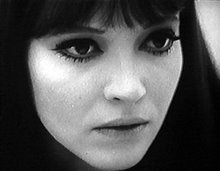
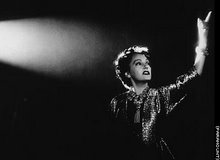
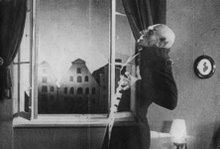
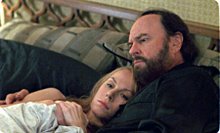
Above, two images from Nicolas Provost's Papillon d'amour, and a photo of Douglas Gordon's Between Darkness and Light (After William Blake).

Last night in class I briefly mentioned the work of artists who use existing films as the material of their work. I brought this up because I was talking about one of the ideas at play in Michael Almereyda's Hamlet: the absolute dominance of film (or more broadly, visual representation/communication media) in contemporary culture. While I want to write more about this in preparation for our discussion session next week, I thought I'd first give you a look at some innovative video art as food for thought.

You can see Nicholas Provost's beautiful Papillon d'amour on YouTube (low res, unfortunately) and read a bit about his work at the Video Data Bank. Papillon d'amour is made from footage of Akira Kurosawa's film Rashomon and I should probably say a bit about it here, too. I've mentioned Rashomon in class because of it's important status in film history and also its interesting handling of narrative structure: its nonlinearity and lack of closure. If you've never seen it, you can actually view the film online via the Internet Archive, a marvelous database of film/video/television images, most of them available in their entirety. Rashomon would fit quite well with the other films we've been looking at in this class, too, since as Stephen Prince points out in his essay for the Criterion Collection's release, "...the film has had a huge impact on modern culture. Rashomon is that rare film which has transcended its own status as film. Rashomon has entered the common parlance of everyday culture to symbolize general notions about the relativity of truth and the unreliability, the inevitable subjectivity, of memory [my emphasis]. In the legal realm, for example, lawyers and judges commonly speak of “the Rashomon effect” when first-hand witnesses of crime confront them with contradictory testimony."

I don't have any clips to show of you of Douglas Gordon's much bigger body of work, but here is a blog which has some interesting commentary on his recent show at MOMA, including 24 Hour Psycho, Between Darkness and Light (After William Blake), and Left is right and right is wrong and left is wrong and right is right, which splits Otto Preminger's Whirlpool into two panels which both mirror each other and consist of every other film frame.

The Guardian has an interesting discussion of Between Darkness and Light (After William Blake), as well as some photos and commentary on other of his work. From the article:

"[In] Darkness and Light (After William Blake)...two films run continuously, on either side of a translucent screen. On one side, Henry King's 1943 historical biopic Song of Bernadette, about Saint Bernadette, whose visions of the Virgin at Lourdes led to her sanctification and the founding of the pilgrimage site. On the other side of the screen runs The Exorcist, William Friedkin's 1973 horror movie of demonic possession. The images and sound from both movies meld and glide apart...There are inadvertent synchronicities between the two films: one is about virtue and goodness (and shot in black and white), the other unadulterated evil (shot in particularly seamy, grubby colour), but both are concerned with faith and doubt. The resulting "third image" is peculiar. The two films seem to haunt one another. Not only that, but the moments that collide so mysteriously are also always different, as the films are of different length and run continuously...heavenly visions juxtapose with evil infestations; the heavenly and the horrible keep crossing over, literally as well as figuratively."

Wednesday, April 4, 2007

Lost All My Mirth: Michael Almereyda's Hamlet


Above, some scenes from the film and director Almereyda on the set.

Michael Almereyda's Hamlet is the only film of a Shakespeare play that I like--that I think is not only good as an interpretation, but also good as a film. One reason for this is that this is a very self-reflexive piece of filmmaking. Besides being about the story of Hamlet, its also a film about the dominance of media, of visual culture, of communications technology in contemporary life. Almereyda manages to work in references to nearly every form of currently existing media. Video abounds; television screens and computer monitors, surveillance cameras and Times Square telescreens are included in nearly every shot. Some of the dialog is delivered via email, fax, teleprompter and answering machine; eavesdropping becomes wiretapping. And Hamlet wields a Pixelvision camera in the film's first extended sequence. As one critic remarked, "this is a Hamlet for the information age."

Almereyda has set his Hamlet in NYC year 2000 and slightly modified a few plot elements: Claudius is CEO of Denmark Corporation, fighting off a hostile corporate takeover by competitor Fortinbras. Elsinore is no longer a castle, but a swank hotel. Claudius and Gertrude make public appearances at press conferences and social benefits, not court.

Ophelia is a trust fund princess slumming on the LES, dressed in couture and sneakers and carting her cameras and photography equipment around in a Manhattan Portage messenger bag. Hamlet is a slacker film school student, a would be video artist obsessively reviewing footage of his life with the smudged door stamp from last night’s club still on the back of his hand. That we live in a world irrevocably mediated by the image is eloquently, wittily, and forcefully brought home by Almereyda's staging of that most iconic of all theatrical moments, Hamlet's "to be or not to be" soliloquy, in a Blockbuster video store.

The film also continually juxtaposes high and low culture elements on every level: the Shakespearian language we hear confronts the contemporary images we see, the soundtrack combines music referencing Hamlet by both classic composers (Tchaikovsky's "Hamlet") and rock musicians (Nick Cave and The Birthday Party's "Hamlet Pow, Pow, Pow"), even the casting carries this theme through by combining figures with pop culture resonance (Ethan Hawke, Julia Stiles and Bill Murray) with those more associated with theatre and Shakespeare (Sam Shepard, Diane Venora, Liev Schreiber).

The film is visually and aurally dense: there's much to look at and much to listen to. The score, by film composer Carter Burwell, is evocative and haunting. I uploaded it all to the Voxblog, Extra Things, if you want to listen to it.

So where can we most profitably place our eyes and ears?

While I think there is much to be said about how Almereyda treats Shakespeare's text, I don't know if that's the best place to begin for a class devoted to narrative. True, Almereyda cuts much, but frankly the last stage production I saw (Andrei Serban's referenced in my post below) ran about the same length of time. I like placing the famous speech from Act II at the beginning ("I have of late, where for I know not, lost all my mirth...") because it both cuts out the backstory blabla of the watchmen and it is my favorite bit in the play (though for me the best rendition of that speech in film remains Richard E. Grant's declamation in the final scene of Withnail & I).

Instead, I think we could begin with looking at the issue of mediation: the way our perception of the world, of how things are, is mediated by narrative and the various media in which it is encoded.

Above all, Almereyda's Hamlet argues for the primacy and power given film in contemporary society. That is why his film references so many forms of the reproduced image, and why he specifically locates the central elements of Shakespeare's play within an explicitly filmic context: Hamlet as aspiring filmmaker and avid film fan, the replacement of the play-within-a-play with a film-within-a-film, the Blockbuster location of "...to be or not to be...," and finally, Hamlet's questions about the reality of feelings emoted on the stage are now asked of a Movie Star, a pop culture icon of passion and action. "What would he do had he the motive and the cue for passion that I have?" asks this Hamlet, not of one of the court players, but of James Dean.

Quintessence of Dust: Hamlet Hell


I wanted to post some links to clips from different versions of Hamlet so students would have some points of comparison with Almereyda's film. I figured we were all familiar with various "classic" renditions, films like Kenneth Branagh's or the Franco Zefirelli/Mel Gibson version which attempt to mount a "faithful" recreation of what they seem to consider a sacred text. There are much more interesting routes to go when confronting the play T.S. Eliot referred to as, "the Mona Lisa of literature."

East German playwright Heiner Miller's, Hamletmachine, for example, is a kind of meta-theatrical commentary that uses the supposed "universality" of the play as an entry point for a far reaching critique of literature and politics. And Andrei Serban's 1999 staging was an attempt to capture not the just the play, but all the versions of it that have become dominant in collective memory.

So I took a brief look through YouTube and found a couple of things of possible interest. Here's a section from a typically "classic" staging, one which features Derek "I, Claudius" Jacobi as Hamlet and Patric "Jean-Luc Picard" Stewart as Claudius. And then there's The Simpson's version, which should be better, but does achieve a certain pathos in the casting of Chief Wiggam as Polonius and Ralph Wiggam as Laertes ("Look! Daddy's stomach is crying!!"). I also came across a clip from Tom Stoppard's film of his play, Rosencrantz and Guildenstern Are Dead, which is kind of nice to look at against the way the same scene is handled in Almereyda's film.

But mostly I found that YouTube is a bottomless pit of everybody's crappy video version of scenes from Hamlet staged for their high school English class. Each one of these imagines itself to be "hilarious" and "original," and yet I found 8 different "lego-mation" versions, at least 16 machinima (drawing from The Sims, Halo, World of Warcraft, Final Fantasy, and Second Life, among others), 22 Star Wars/Hamlet fusions and "gangsta" and rap Hamlets beyond count ("Homeboy Hamlet," "Hamlet in Da Hood," etc.). Apparently, if you give white suburban American teenagers a video camera the first thing they do is recreate some "jackass" stunts and then they move on to pretending they're both black and Shakesperian actors. I'll let you mine YouTube for "gems" yourselves.

You can also find some of the videos linked to here over on my VoxBlog, Extra Things, along with the one actually interesting thing I found on YouTube: Andrew Bellware's Hamlet short. I don't know anything about him or his production company, PandoraMachine, but the film was shot in Pixelvision, a "method" pioneered by Michael Almereyda in his first film, Another Girl, Another Planet, and something which has become almost a signature for him---you'll see bits shot on Pixelvision in Hamlet and I think all his other films as well.

Tuesday, April 3, 2007

Man delights not me: Shakespeare's Hamlet


Shakespeare’s Hamlet is probably the most famous play in the English language. One reason for its continued popularity is its seemingly “modern” rendering of individual psychology and motivation. Although there is plenty of onstage action, the play’s emphasis is really on internal battles: Hamlet’s struggle with himself, his indecisiveness and inability to act in ethically complicated situations make it an ideal text for multiple interpretations.

The following is a quick n’ dirty synopsis of the play’s plot. It should help with any major trouble you may have in reading the play. If you want a more detailed, act-by-act and scene-by-scene description you can look here, but I don’t think that will be necessary as Almereyda makes extensive cuts and revisions in the play.

Hamlet, the son of the King of Denmark, has come home to Castle Elsinore for his father’s funeral. Hamlet’s mother, Queen Gertrude, has married the former King’s brother, Claudius--who is now himself King. Hamlet is still mourning his father’s death and visibly disturbed and depressed over his mother’s remarriage. He doesn’t like Claudius and he’s acting weird around his girlfriend, Ophelia. Ophelia’s brother, Laertes, and father, the Lord Chamberlain Polonius, warn her that Hamlet might be only playing with her affections.

The neighboring kingdom of Norway (specifically Prince Fortinbras) is threatening to invade. One night, some watchmen see a ghost resembling King Hamlet. Hamlet and his closest friend Horatio talk to it and learn that his father was murdered by Claudius---by having poison poured in his ear. The ghost wants Hamlet to avenge him but he’s not entirely sure how best to get this revenge.

Claudius and Gertrude notice Hamlet’s increasing anti-social behavior (or madness) and they appoint two of his school mates, Rosencrantz and Guildenstern to spy on him. Claudius is worried that Hamlet suspects something. Polonius on the other hand, bumblingly thinks Hamlet is just moody and lovesick for Ophelia. He, too, spies on Hamlet and Ophelia to report back to Claudius. Hamlet breaks with Ophelia.

Hamlet decides to trick Claudius into betraying himself by staging a play which recreates the murder of King Hamlet. The play upsets Claudius, clinching Hamlet’s resolve, but when he goes to kill him, Claudius is in prayer and Hamlet cannot follow through. He then confronts his mother and hearing a noise behind her bedroom curtain, stabs at it, thinking it Claudius. He has, however, killed Polonius. Claudius sends him back to England, ostensibly for his own safety, but in reality he’s also sent Rosencrantz and Guildenstern with orders for his death.

Ophelia, already upset by Hamlet’s rebuff, now goes mad in grief at her father’s murder. She drowns, perhaps a suicide. Laertes, her brother and Polonius’s son, returns in a rage from France, demanding that Claudius punish Hamlet. Hamlet sends word that he’s returning, and realizing his plot didn’t work, Claudius hatches a new one with Laertes: to challenge Hamlet to a fencing match. Laertes will bring a poisoned blade; Claudius will provide a poisoned cup. During the match, Gertrude drinks from the poisoned cup instead and Laertes fatally wounds Hamlet, but is himself wounded with his own sword. As he dies, he tells Hamlet about Claudius’s plot and Hamlet kills Claudius. Hamlet dies begging his dear friend Horatio to tell the story. Fortinbras and his army enter the castle to begin a new regime.

Friday, March 23, 2007

Storytelling


Above, three images from the film we screen this week, Todd Solondz's Storytelling, including one featuring The Red Box.

I want to point out a few things for students to watch for and think about: the film's bifurcated structure and, of course, the infamous Red Box.

Storytelling is a diptych of sorts: it consists of two separate films, one titled "Fiction," and the other titled "Nonfiction." While the two sections share some implicit themes (like the in/interdeterminacy of the supposedly opposite categories of "fact" and "fiction") on the surface they seem unrelated and could stand alone as independent narratives. "Fiction" is the story of young student enrolled in a creative writing seminar, and "Nonfiction" relates the story of a would-be documentary filmmaker. Each of the main characters is in some sense committed to telling "the truth," but that turns out to be a less straightforward proposition than often assumed. Of interest to our class is how the film takes up autobiography and documentary in its double structure.

"The Red Box" is how director Solondz handled the problem of ratings and censorship, a problem specific to the United States but not elsewhere on the planet except, as he points out, "in places like Iraq and Iran." In the United States in order for films to get wide distribution they must be "voluntarily" submitted to the MPAA for a rating (voluntary in name only because of studio/distributor pressure to comply). Ratings have a direct effect on box office and thus on whether or not your film will ever get seen. The criteria used to determine ratings are obscure, arbitrary and often contradictory. The bottom line? Studios and distributors want to avoid a rating of "NC-17," which in 1990 replaced the "X," but still carries a stigma. (For a history of MPAA ratings and the struggles waged by various filmmakers, this wikipedia entry is a good place to start.)

When Solondz first presented Storytelling to the MPAA, he was told he would have to remove a sex scene between a white female and a black male in order to earn an R rating. But Solondz had covered himself in his contract as explained in this interview: "I had it in my contract that I had the ability to put boxes and beeps wherever necessary in order to procure the "R" rating; I feel the audience is entitled to know what they're not allowed to see. The alternative is to remove the shot, and this is something I found unacceptable. You only get the opportunity to see the red box in this country...I chose red because I didn't want it to be subtle...I needed a very strong color to pop out so there would be no ambiguity. It's not a mistake; it's right in your face: You're not allowed to see this in our country."

In a gesture worthy of Hester Prynne, Solondz not only chose the colour scarlet , but also made sure his signifier of sexual repression was obnoxiously large: The Red Box, as you can see above, stamps out more than just an actor's "naughty bits," it interrupts the narrative itself.

Hypertext


One of the written texts you might be using for your second essay is a hypertext work: Shelley Jackson's "My Body: A Wunderkammer." So this post is to help familiarize you a bit with some of the history of this digital format and its use as a creative medium.

Hypertext, the ability of html code to render online text with embedded links to other texts, images, or other kinds of data files, is ubiquitous throughout the internet. I don't know where you could look online and not be looking at some use of it. I'm sure everyone in class is by now used to seeing words and phrases highlighted in different colours that you "click" on to take you to somewhere else: a different web page, a definition of a term, an email address, and so on. Its pretty much what the internet was set up to do.

Hypertext was invented as a means to provide an easy interface for information retrieval, a way to organize and cross-reference both the knowledge of the past and the vast amounts of data being generated by digital technology itself. In short, a solution to the 20th Century problem of information overload. Any history of hypertext usually begins with reference to Vannevar Bush's prescient essay, "As We May Think," published in 1945. In it he imagines an electronic device he calls a "Memex." This "mechanized file and library" would be produced for individual use and take the form of a screen-topped desk and keyboard. Though Bush's "Memex" is not exactly like a PC hooked up to the internet, the basic idea---a means for individuals to have virtual access to a meta-archive---is there. That's why Bush's essay was the inspiration for the men generally credited with hypertext's invention, Ted Nelson and Douglas Engelbart.

What is interesting about Bush's predictions for later creative and artistic uses of hypertext and hypermedia are these comments that follow his criticism of the conventional ways information is indexed:

"The human mind does not work that way. It operates by association. With one item in its grasp, it snaps instantly to the next that is suggested by the association of thoughts, in accordance with some intricate web of trails carried by the cells of the brain. It has other characteristics, of course; trails that are not frequently followed are prone to fade, items are not fully permanent, memory is transitory. Yet the speed of action, the intricacy of trails, the detail of mental pictures, is awe-inspiring beyond all else in nature.

Mankind cannot hope fully to duplicate this mental process artificially, but ... [t]he first idea, however, to be drawn from the analogy concerns selection. Selection by association, rather than indexing, may yet be mechanized. One cannot hope thus to equal the speed and flexibility with which the mind follows an associative trail, but it should be possible to beat the mind decisively in regard to the permanence and clarity of the items resurrected from storage."

Yes, that's right. The non-linear associative function of memory is here imagined as the ultimate organizing methodology for categorizing everything. This should give pause to those readers who still find the nonlinear "confusing," "annoying," or "stupid."

Because hypertext is a way of organizing material that attempts to overcome the inherent limitations of the linearity of traditional text its easy to see why it would be a medium that invited creative uses. As Heather pointed out in class, it changes things on a very fundamental level. The narrative experience, no matter what the structure or medium, has always been an experience of finite duration. The final page is turned, or the credits roll and the lights go up, and its over. Heather's very good question was, "How do you know when to stop?"

Wednesday, March 21, 2007

Camera Eye: This American Life Clip


This is the animated short I mentioned in class last night. It's a segment from the new This American Life series on Showtime. I titled it "Camera Eye;" I don't know what it will be called when its broadcast.

It follows the typical format of a piece on the NPR radio program, This American Life: someone telling a "true story." In this case, the show's host, Ira Glass, is interviewing someone (Jeff) about a playground craze they remember from grade school. Their conversation is paired with an animation by the artist Chris Ware.

I thought it might have relevance for our class for several reasons. The story is about memory. The story is autobiographical and presented within the frame of a program that itself is a kind of documentary/autobiography hybrid. And, the story is about the mediation of "real life" by the camera: something with consequences even when the camera isn't real.

I'm also interested in the way that the audio narrative is supplemented with visual images too. The Showtime series marks the negotiation of This American Life between different media. Formerly, the fact that it was a radio program, a purely aural experience, was essential to the nature of the program. It was a narrative form grounded in talking and listening, not looking. How will the addition of visual elements change this?

In this segment we see one approach, one that doesn't pair the audio with filmed footage of the incident, but with an obviously artificial illustration---a cartoon drawn in simple geometric shapes.